Artikel: Arabic Machine Embroidery: How to Get Clear, Beautiful Arabic Lettering
Arabic Machine Embroidery: How to Get Clear, Beautiful Arabic Lettering
Arabic names and calligraphy can create beautiful embroidery.
They can also be surprisingly challenging to digitize well.
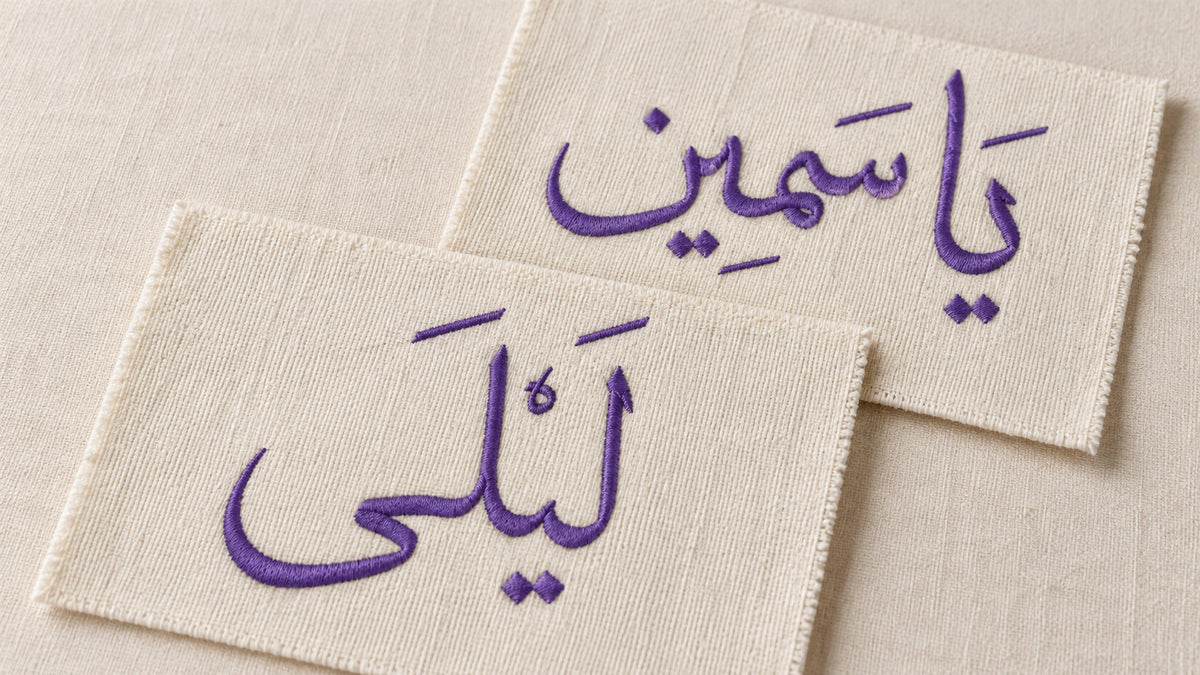
Arabic lettering contains connected characters, changing letter shapes, dots and delicate details that may look perfectly clear on a screen but become difficult to read once converted into thread.
Successful Arabic embroidery therefore requires more than choosing an Arabic font and pressing “convert.”
Why Arabic embroidery needs special attention
Embroidery thread has physical thickness.
A very thin computer font line cannot always be reproduced at the same scale with thread.
Small gaps may close.
Tiny dots may merge.
Delicate strokes may become too heavy.
Connected letters can lose their shape when the design is made too small.
The digitizing process therefore has to balance the appearance of the original Arabic lettering with what can physically be embroidered.
Arabic letters change shape
Unlike English lettering, many Arabic characters change form depending on where they appear in a word.
Letters may connect from one side or both sides, and the spacing between letters is an important part of readability.
A digitizer therefore needs to preserve the structure of the word rather than treating every character as an isolated symbol.
Dots are especially important

Dots can completely change the meaning of Arabic letters.
For example, several characters share a similar basic form and are distinguished by the number or location of their dots.
That makes dot placement particularly important when digitizing Arabic text.
At very small sizes, dots may need to be adjusted so they remain clearly visible after stitching.
Choosing an embroidery-friendly Arabic font
Not every beautiful Arabic font works equally well in embroidery.
Fonts containing extremely thin strokes, tiny decorative details or very tight spacing may become difficult to embroider cleanly at small sizes.
For smaller embroidery, simpler and slightly heavier letterforms are usually easier to reproduce.
More decorative Arabic calligraphy can work beautifully when enough embroidery space is available.
Why the finished size matters

One of the most important details when ordering an Arabic embroidery design is the required width or height.
A name designed for a large back embroidery can contain more detail than the same word embroidered on a small chest area.
This is why simply resizing an existing embroidery file is not always ideal.
Very small lettering may require simplification or a different stitch approach to remain readable.
There is no single minimum size that works for every Arabic design.
The practical minimum depends on factors such as:
font style, stroke thickness, number of letters, fabric, thread and overall design width.
Satin stitch or another stitch style?
Satin stitch is commonly used for embroidered lettering because of its smooth and attractive finish.
However, the width of each stroke matters.
Very narrow or unusually wide areas may require different treatment.
For some decorative Arabic designs, a combination of stitch types may provide better results than forcing the entire design into one stitch style.
Fabric matters too

The same Arabic name can behave differently on different materials.
Stable woven cotton provides a different embroidery surface from:
- stretchy clothing
- towels
- fleece
- caps
- thick sweatshirts
The choice of stabilizer, embroidery density and underlay should suit the final project.
If you are ordering a custom Arabic design, telling the digitizer what you plan to embroider can help produce a more suitable file.
What information should you provide?
When requesting a custom Arabic name or phrase, it helps to provide the exact Arabic spelling rather than relying only on transliteration.
Also include the intended embroidery dimensions, required machine format and fabric or product.
If you have a specific Arabic font or calligraphy style in mind, you can provide a reference image.
The clearer the information, the easier it is to preserve the intended appearance.
Always check the preview carefully
Before stitching a custom Arabic design, inspect the preview to confirm:
- spelling
- letter connections
- dots
- line arrangement
- general proportions
This is particularly important for names, religious phrases and calligraphy where even a small text error matters.
Arabic embroidery at Amer Embroidery Studio
Arabic embroidery is one of the specialty services offered by Amer Embroidery Studio.
Custom names and lettering are prepared with attention to readability, letter connections, spacing and the limitations of machine embroidery.
Designs can be supplied in popular embroidery formats such as PES, DST, JEF, VP3 and others depending on the project.
Looking for a custom Arabic embroidery design?
Or browse the existing: